
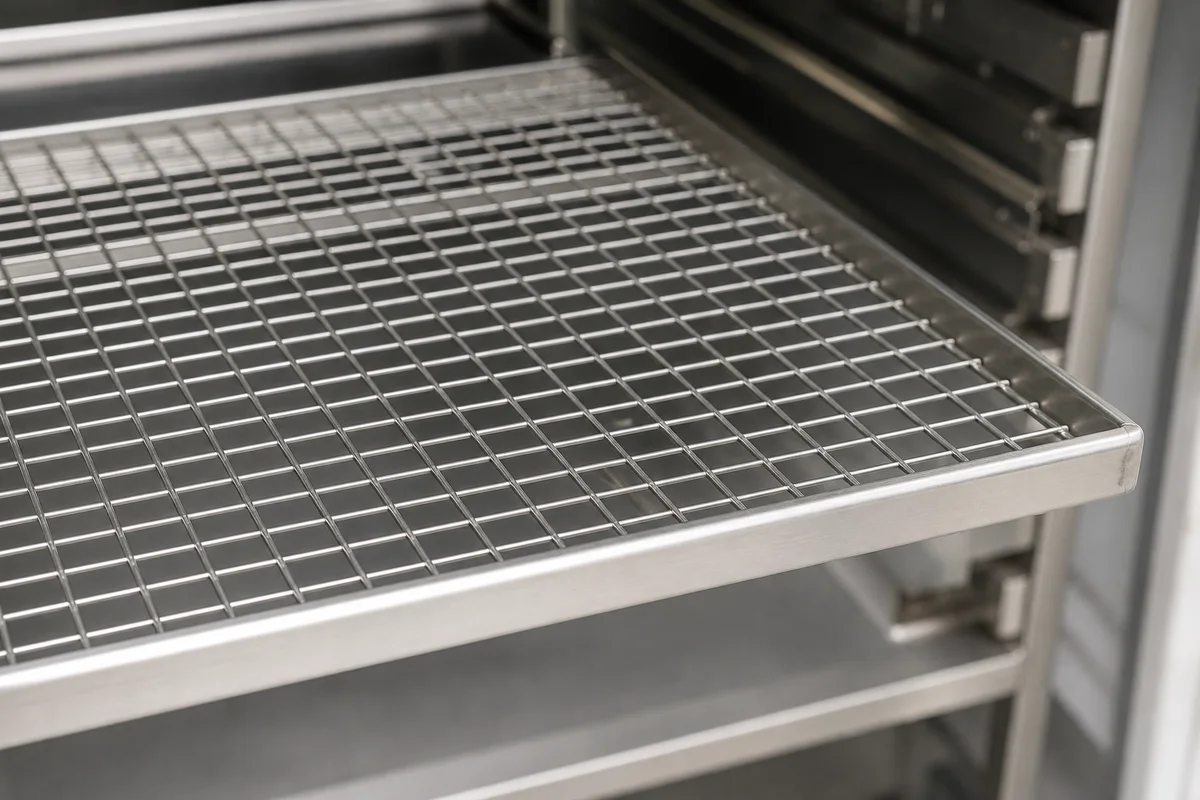
Stainless steel welded wire mesh can be supplied as a roll, cut sheet, or framed panel for drying, baking, food-processing, and clean-equipment projects where a rigid square grid is required. The mesh shown here is made from straight stainless steel wires joined at each crossing to form square openings. It is structurally different from a fine woven filter cloth, a flexible cable net, or expanded metal sheet, so the construction should be named clearly in the enquiry.
For an accurate quotation, buyers should describe the equipment interface rather than ordering only “stainless mesh.” The required material grade, welded-grid opening, wire diameter, finished roll or sheet size, frame detail, edge finish, panel quantity, packing, and destination all affect the right product format. The equipment drawing and the responsible process or hygiene specification should define the final requirement.
Where welded stainless mesh fits in drying and baking equipment
A square welded mesh grid may be used as a tray insert, rack panel, guarded support, or fabricated component inside drying or baking equipment when the project design calls for this construction. It can support airflow through an open grid while a separate frame or rack gives the finished panel its handling and mounting arrangement. A roll is not automatically a finished tray: the required flatness, cut size, edge treatment, and frame connection should be confirmed before production.
The 316 stainless steel mesh product reference is the direct catalogue starting point for food-processing and clean-equipment enquiries. Provide the actual mesh construction required by your drawing, together with the application, grade, opening, wire diameter, panel or tray size, quantity, packing, and destination. This avoids selecting a material by product name or photograph alone.
Specify welded grid, not a generic stainless screen
Welded mesh uses straight wires joined at their intersections. A woven screen uses warp and weft wires interlaced together, and it is normally described by weave and mesh count. These products can look similar at a distance but behave differently in cutting, forming, support, cleaning, and final fabrication. A buyer requiring a square welded grid should state that requirement explicitly; a buyer requiring a woven filtration screen should instead provide the weave and filtration specification.
For applications focused on fine filtration or screening rather than tray or panel fabrication, review the stainless steel woven filter mesh guide. Drying and baking equipment often needs a more complete component definition: the grid is only one part of the finished tray, rack, or machine insert.
Material grade must follow the process requirement
Stainless steel grade should be selected from the project's process environment, cleaning method, and applicable equipment requirement. Common grades such as 304 and 316 are not interchangeable by default. The material decision may depend on moisture, cleaning chemicals, operating conditions, the surrounding equipment, and the project specification. State the requested grade in the RFQ and attach the relevant material or inspection requirement where one exists.
A material reference in a catalogue is not a substitute for a product-specific approval, compliance review, or hygiene validation. If a project has requirements for food-contact suitability, traceability, cleaning validation, surface finish, or a particular standard, the buyer should provide those requirements to the responsible project parties and include the applicable purchasing requirement with the enquiry.
Confirm the opening and wire diameter together
The opening describes the square clear space between wires, while the wire diameter affects the stiffness, weight, open area, and way the mesh performs in a frame. The finished mesh should therefore be specified as a complete grid: opening, wire diameter, material grade, weld condition, and finished dimensions. A visual reference or a single nominal dimension does not define all of these variables.
For a framed tray or rack insert, provide the outside frame dimension, usable internal area, required mesh orientation, edge overlap or trim, and the intended support points. A simple sketch is often more useful than a generic picture because it shows whether the mesh needs to sit on a ledge, be welded to a frame, be removable, or be supplied as a loose cut sheet.
Frame, edge treatment, and removable-panel details
When mesh is delivered as a finished tray or panel, the frame and edge treatment are part of the product definition. The drawing should state whether the mesh is cut flush, turned, enclosed, welded to a border, or seated inside a separate support frame. Sharp exposed ends, loose wires, unsupported spans, and inconsistent panel sizes should be addressed at the design and fabrication stage rather than after shipment.
Some equipment needs removable inserts for cleaning or replacement, while other projects require fixed panels. Identify the handling method, expected panel orientation, mounting points, and any clearance around the equipment rack. The food processing mesh application range gives related product context, but the final order should always stay with the approved tray, rack, or panel drawing.
Inspection and handling before shipment
Inspection should follow the confirmed order details: material grade as specified, opening, wire diameter, weld appearance, sheet or panel dimensions, frame detail, surface condition, quantity, and packing marks. Where the buyer needs evidence before loading, request measurement photographs, panel photographs, material documents when agreed, bundle counts, and packing-list references. Agreeing this check list early makes receipt inspection more straightforward.
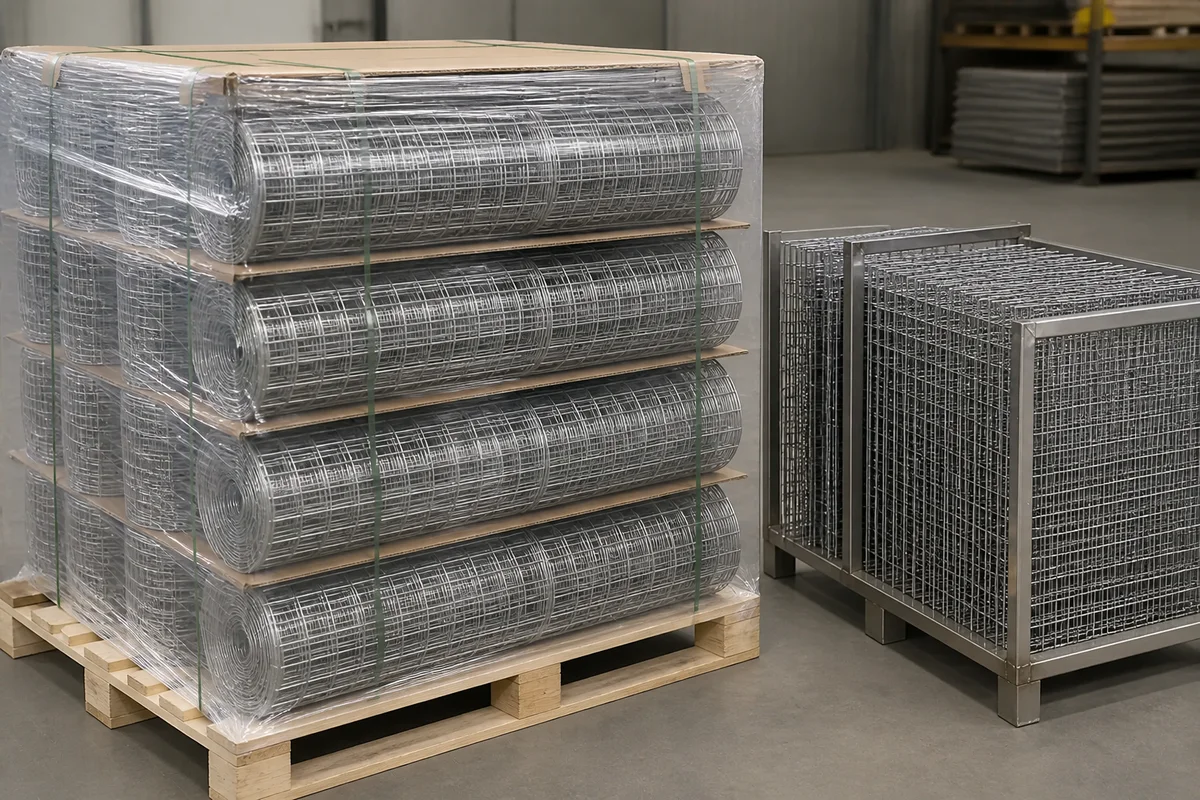
Keep rolls, sheets, and framed panels supported and protected from unnecessary impact during handling. Different panel sizes or mesh constructions should be separated and labelled clearly. If the order combines loose rolls with fabricated frames, list each component separately on the packing request so that receiving teams can identify which items belong to each equipment reference.
RFQ checklist for drying and baking mesh
- Application and equipment drawing: tray insert, rack panel, drying cabinet, baking equipment, or another defined clean-equipment component.
- Required mesh construction: square welded grid, woven screen, or another specified structure.
- Material grade, opening, wire diameter, weld or weave requirement, and requested surface condition.
- Finished format: roll, cut sheet, framed panel, tray insert, or custom equipment component.
- Outside dimensions, usable area, edge finish, support or mounting detail, quantity, and component schedule.
- Inspection evidence, packing method, labels, destination, and loading requirement.
The stainless steel wire mesh category provides additional product formats for comparison. Send the equipment drawing, mesh specification, material requirement, finished dimensions, quantity, packing request, and destination through the Anping Mesh Factory contact page for a quotation based on the actual equipment project.