
Stainless steel woven filter mesh is made by interlacing wire in a regular pattern to form a stable, fine opening. Supplied as a sheet or cut piece, it is used where an application needs controlled passage of solids or fluids, product retention, a protective screen, or a supported filter layer. The useful product description is not simply “stainless mesh”: the weave, opening, wire size, alloy, cut size, and mounting method all affect whether the finished part will work in the equipment.
Our 304/316 stainless steel woven filter mesh sheet is available for industrial use as a cut-size mesh component. It is appropriate to discuss with the actual process, equipment drawing, retained particle or screening requirement, operating environment, and final part size in hand. That gives both sides a clear basis for matching the mesh to the job.
What a woven filter mesh sheet does
In a filtration or screening assembly, a woven mesh sheet provides a repeatable pattern of openings across the active area. It may sit in a circular frame, a rectangular cassette, a perforated support, a basket, or a fabricated guard. The mesh can be the working separation layer, a support for another medium, or a screen that keeps larger particles from reaching downstream equipment.
Woven mesh should be distinguished from perforated plate, welded wire mesh, and expanded metal. Perforated plate is produced from punched holes in sheet metal; welded mesh is made from wires joined at intersections; expanded metal is slit and stretched from a continuous sheet. Each can be useful in an industrial assembly, but a fine woven filter mesh is selected when the controlled woven opening and flexible cut-to-size sheet form are needed.
Begin with the filtration or screening duty
Before choosing a mesh count or opening, describe what the component must do. State whether the mesh will retain particles, protect a pump or process line, support a filter layer, screen dry material, or provide an inspection screen. Include the material being processed, whether it is dry or wet, expected temperature, cleaning method, pressure or flow condition where relevant, and the required finished shape.
A small opening is not automatically the best answer. Finer mesh can retain smaller material, but it may also change flow behavior, cleaning frequency, and the way the sheet needs to be supported. A larger opening may suit a coarse protective screen but not a finer separation step. The required performance should lead the mesh selection; a sample, drawing, or retained-material description is more useful than a general request for “fine stainless screen.”
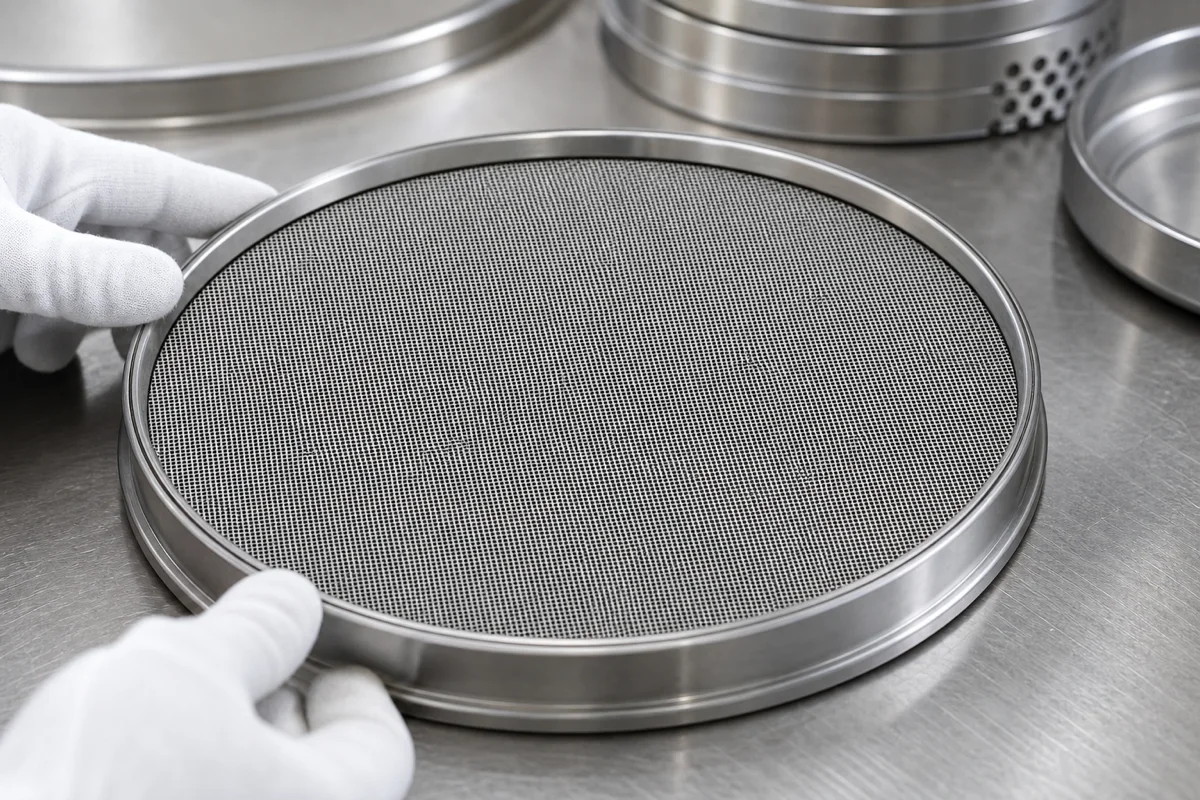
Specify opening, weave, and wire diameter together
Buyers often use mesh count, aperture, micron rating, or wire diameter when discussing fine woven mesh. These terms are related but they are not interchangeable. Mesh count describes the number of openings over a stated length; aperture describes the clear opening; wire diameter is the diameter of the wire itself. The weave pattern also affects the surface, stability, and available open area.
For a practical quotation, provide the requested mesh count or opening together with wire diameter and weave when they are known. If the project is based on an existing filter, send a physical sample or clear close-up images with the overall component dimensions. Where a filtration performance value is critical, identify the test method or equipment requirement rather than assuming that two descriptions from different systems mean the same thing.
Choose 304 or 316 against the service environment
304 and 316 stainless steel are commonly requested for woven filter mesh, but the final material should be selected for the actual service environment. Humidity, cleaning chemicals, chloride exposure, process media, temperature, outdoor storage, and contact with other materials can all matter. A grade name alone does not describe the whole assembly: the edge treatment, frame material, welds, and cleaning routine should be compatible with the intended service.
For a broader explanation of grade information before confirming a request, see our stainless steel wire mesh grade selection guide. It explains why an application description is needed alongside the alloy request, especially when corrosion resistance or repeated washing is part of the working condition.
Cut size and assembly details prevent avoidable rework
Many industrial buyers require a finished mesh part rather than a full roll. Confirm the final diameter, length and width, outside profile, tolerance, mesh orientation where relevant, and the number of pieces. For circular parts, state the inside and outside diameter of the frame and where the mesh is retained. For rectangular pieces, identify corners, notches, fixing holes, folds, edge strips, and any overlap required by the assembly.
A woven mesh sheet should be handled as a functional component. Fine wire can be affected by uncontrolled cutting, creasing, edge distortion, or contact with a poorly matched support plate. Where the mesh will be clamped or welded into a frame, provide the assembly drawing and identify which side faces the process. This lets the cut size and support detail be checked before the part is produced.
Inspection and packing should match the finished component
For cut sheets and framed components, useful checks can include material confirmation as agreed, mesh appearance, opening and wire specification, finished dimensions, clean cut edges, flatness, frame fit, and the condition of protective packing. Fine mesh should be protected against bending, abrasion, and contamination during handling and export transport. The packing request should state whether individual separation, flat cartons, pallet protection, or custom labels are needed.
To prepare a focused quotation, send the use case, material preference, mesh or opening requirement, finished drawing, quantity, inspection requirement, packing method, and destination through the Anping Mesh Factory contact page. A complete request reduces the risk of receiving a mesh sheet that is correct in material but unsuitable in opening, size, support, or assembly form.