
Stainless steel rope mesh is a flexible cable mesh made by joining intersecting stainless steel wire ropes into a regular diamond pattern. It is used where a project needs a transparent-looking barrier, a shaped safety infill, or a durable enclosure that follows a frame rather than behaving like a rigid welded panel. Typical uses include stair railings, balcony guards, atrium protection, bridge or walkway barriers, animal enclosure partitions, and custom architectural screens.
For buyers, the important distinction is that this is not ordinary chain link fence, welded wire mesh, or woven filter cloth. The mesh is made from stainless steel cable strands and ferrule joints. Its flexibility makes it useful around sloped stairways, curved frames, and custom opening sizes, while the final performance depends on the selected cable construction, cable diameter, diamond opening, edge treatment, support frame, and fixing method.
When stainless steel rope mesh is the right product
Stainless steel rope mesh is often selected when visibility and a clean architectural finish matter alongside protection. On a stairway or balcony, the mesh can form an infill between posts and handrails without closing off light or sightlines. In an animal enclosure, it can provide a flexible stainless barrier with a specified opening and properly designed support structure. For a custom barrier, the panel may be supplied to a finished width and height, or sized around a project drawing so the installer can tension and fix it to the frame.
The 304/316 stainless steel rope mesh product page is the relevant starting point for architectural safety, flexible enclosure, and balcony or stair infill enquiries. The final mesh selection should always be reviewed with the project drawing, local code requirements, loading conditions, supporting structure, and installation method. A mesh panel alone is not a complete guardrail design.
Specify cable construction, diameter, and diamond opening
Every rope mesh order begins with three connected choices: cable construction, cable diameter, and opening size. Cable construction describes how the individual wires are assembled into the rope. It influences the appearance, flexibility, and handling characteristics of the mesh. Cable diameter affects the overall feel and strength of the mesh system, while the diamond opening affects visibility, containment requirements, and the number of fixing points across a panel.
Opening size should not be selected only by appearance. A stair barrier, animal enclosure, or elevated walkway can have different containment needs, so the opening must be checked against the intended use and the relevant project requirements. Cable diameter should likewise be matched to the panel dimensions, support spacing, expected duty, and specified design loads. A buyer who provides only “stainless cable net” without these details will usually receive an incomplete comparison.
For material, 304 stainless steel is commonly considered for many indoor or normal-environment installations. Where the environment has higher chloride exposure, coastal conditions, chemical exposure, or another demanding corrosion concern, the project team may consider 316 stainless steel and confirm the complete installation system. The stainless steel wire mesh grade selection guide gives useful background on discussing grade requirements, but it does not replace the project material specification.
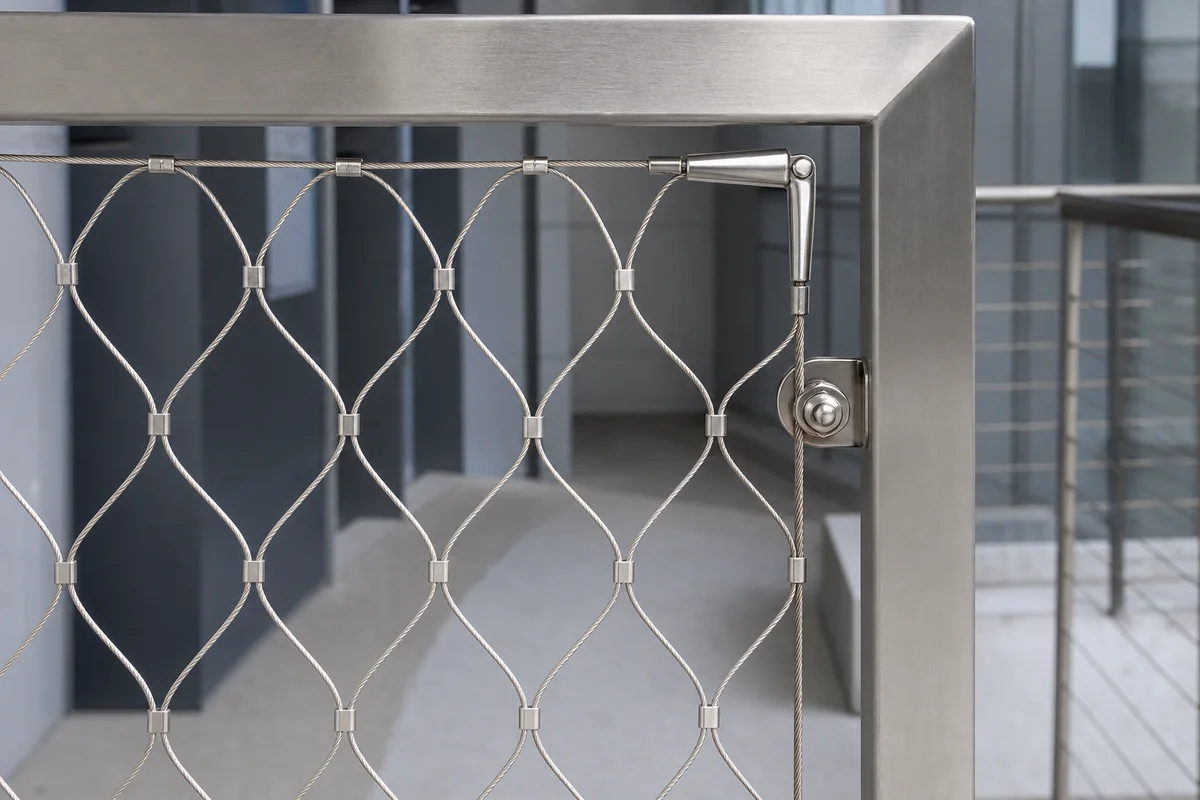
Panel edge and fixing method need the same attention as the mesh
A rope mesh panel must transfer force to a suitable frame or cable system. The panel edge can be prepared with an eye-bar, seamless rope edge, ferrule connection, lacing rope, or another specified termination method. The right choice depends on the supporting posts, frame profile, installation sequence, panel shape, and tensioning arrangement. It is therefore useful to send a drawing or clear frame photographs along with the required panel dimensions.
On a stair installation, the incline affects the final panel shape. The buyer should identify the total panel width and height, the angle or elevation change, post centers, frame opening, and whether the mesh will be fixed on the inside or outside of the support frame. For a curved or irregular opening, a dimensioned drawing is more reliable than a single overall measurement. If several panels are required, each panel reference should be marked clearly to prevent mix-ups during installation.
Plan the architectural use before quotation
Architectural rope mesh is normally a project-specific product rather than an off-the-shelf roll selected by one measurement. A practical inquiry explains the application, panel count, frame material, panel shape, finished dimensions, cable specification, opening requirement, material grade, and expected installation hardware. If the project has a loading requirement or an approved calculation, it should be shared with the responsible engineering and installation teams before the mesh is ordered.
For animal enclosure work, the intended species and containment requirement are relevant because they influence opening selection, panel layout, edge security, gate details, and support design. For balcony, stair, atrium, and walkway work, the buyer should distinguish between a decorative screen and a safety barrier. Safety-critical installations should be designed, approved, and installed by qualified project professionals in accordance with the applicable local requirements.
Check the finished panel, not only the flat mesh area
When comparing quotations, confirm whether the stated dimensions describe the finished outside dimensions, the clear mesh area, or the frame opening. The difference becomes important when an edge rope, eye-bar, lacing, or terminal fitting is included. The buyer should also verify the mesh orientation: a diamond opening can be installed with the long direction vertical or horizontal, which changes the panel appearance and may affect how the mesh follows an opening.
For a consistent architectural package, list each panel separately and include its reference, quantity, orientation, dimensions, edge detail, cable diameter, opening, grade, and required accessories. The stainless steel wire mesh category is useful when comparing rope mesh with other stainless mesh forms used for screens and custom fabrication, but rope mesh should be quoted as its own cable-and-fitting system.
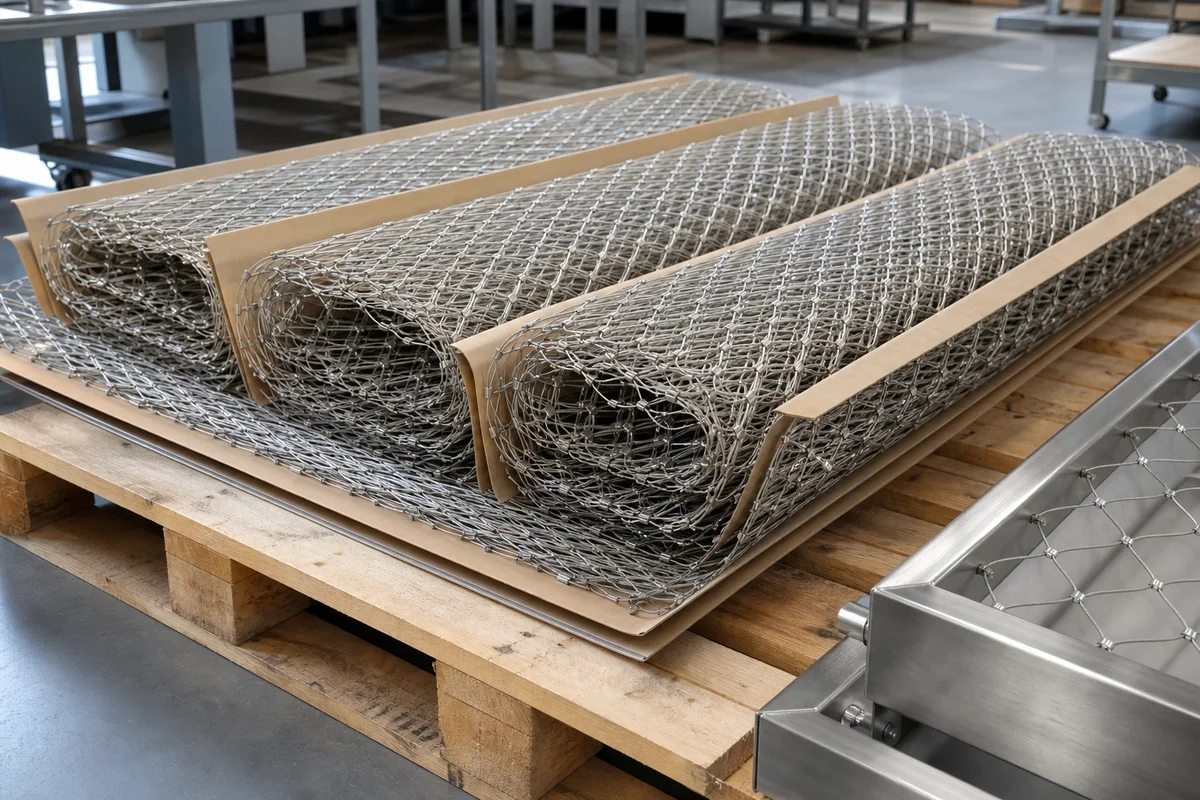
Packing and identification for multi-panel projects
Stainless rope mesh is flexible, so packing should prevent abrasion, tangling, and loss of panel identification. Depending on the panel size and edge treatment, panels can be rolled, folded carefully with separators, or packed flat where the finished geometry requires it. Cardboard, protective wrapping, edge protection, and suitable pallet support help protect the cable and ferrules during loading and transport.
For a multi-panel order, request a packing list that connects each bundle to a panel reference. Include finished dimensions, mesh orientation, opening, cable diameter, grade, and quantity on the relevant label where practical. The broader wire mesh importer buying checklist can help organise quantity, packing, inspection, destination, and loading questions across a mixed order.
RFQ checklist for stainless steel rope mesh
- Application: stair railing, balcony guard, atrium barrier, walkway, animal enclosure, facade screen, or custom frame.
- Material grade: 304, 316, or the grade specified by the project.
- Cable construction and cable diameter.
- Diamond opening size and mesh orientation.
- Finished panel dimensions, quantity, shape, and panel-reference drawing.
- Edge preparation, terminal fittings, support-frame details, and installation method.
- Required accessories, packing method, labels, destination, and requested inspection records.
A complete inquiry makes the quotation more useful because the mesh, panel geometry, edge detail, and packing can be reviewed together. Send your drawing, opening size, cable requirement, finished panel schedule, material grade, quantity, and destination through the Anping Mesh Factory contact page for a specification-based review.