
Expanded metal mesh is a continuous sheet that has been slit and stretched to create diamond-shaped openings. It is commonly considered for machine guards, ventilation screens, protective enclosures, walkways, partitions, and fabricated panels because the sheet retains a connected metal structure while allowing airflow and visibility.
Our galvanized and stainless expanded metal mesh product is intended for guards and screen applications. A good request should identify the working environment, sheet form, opening pattern, material and finish requirement, frame or mounting method, and the protection objective before production is arranged.
Expanded metal is not woven mesh or welded mesh
The diamond pattern in expanded metal is formed from one sheet, rather than from individual wires that are woven or welded together. This difference affects rigidity, edge condition, fabrication, and the way a panel is mounted. Buyers should avoid using a general word such as “metal mesh” when the project requires a continuous expanded sheet.
When sending a sample photo, confirm that the opening is a stretched diamond rather than a square welded opening, a woven screen, or a perforated round-hole sheet. The requested pattern, strand direction, and sheet orientation should be visible on the drawing so that the panel is cut and framed in the intended direction.
Start with the protection or ventilation task
A machine guard panel may need to prevent hand access while still allowing operators to see moving equipment. A ventilation screen may need to protect an opening while preserving airflow. A partition may need a balance of visibility, rigidity, and appearance. These uses are related, but they do not require the same opening size, sheet thickness, frame detail, or finish.
For guards around equipment, provide the hazard-clearance rule, mounting points, panel size, access-door requirement, and any local safety standard that applies to the installation. For ventilation, state the opening size, available frame depth, required free-air path, cleaning conditions, and whether the panel will be removable for service.
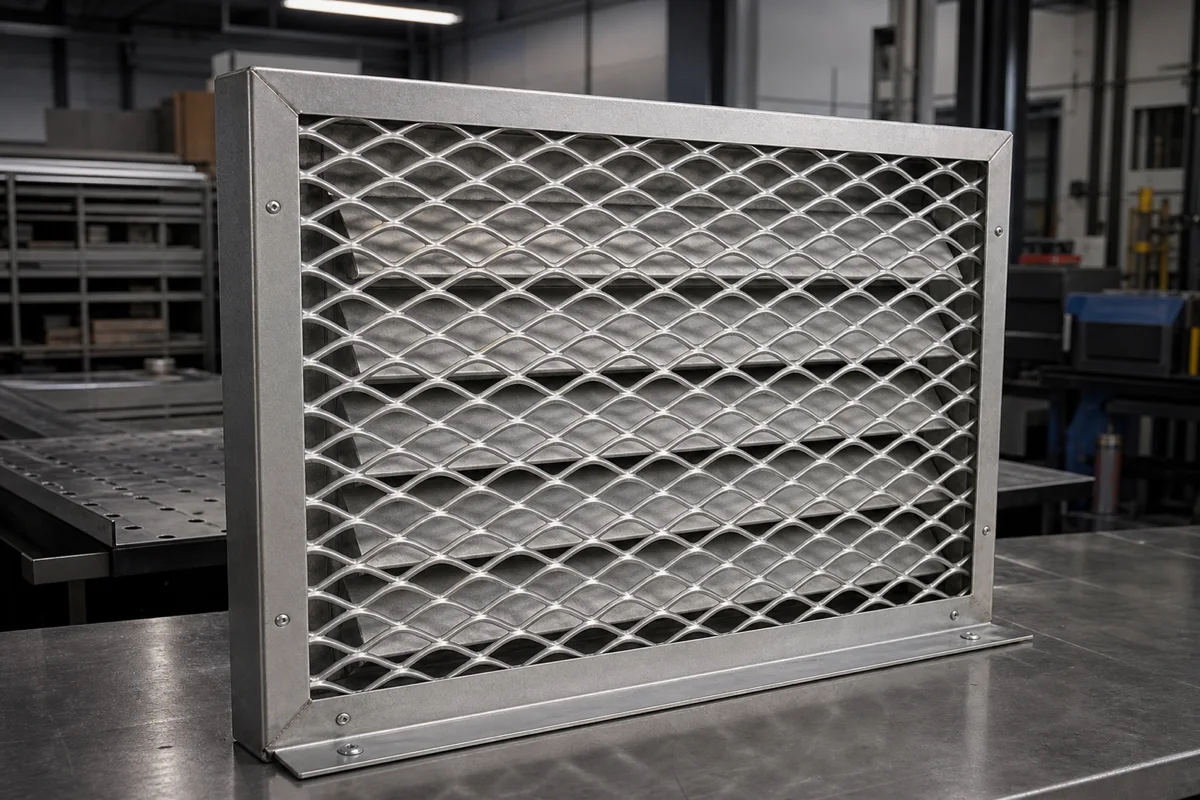
Define the diamond opening and strand direction
Expanded metal is commonly described by its diamond opening, strand arrangement, sheet thickness, and overall sheet or cut-panel size. The opening should be considered alongside the required protection level and the way the panel will be supported. A larger diamond may improve visibility and airflow, while a smaller opening may be needed where access protection or containment is more important.
Orientation matters when the panel is framed or when the finished surface has a preferred visual direction. Include the long-way and short-way direction on the drawing rather than relying on an unmarked photo. If panels must fit a repeated enclosure, provide all cut-outs, corners, overlaps, and edge returns before quotation.
Choose material and finish for the actual environment
Galvanized steel, stainless steel, and other specified materials may be considered according to the end use. Outdoor exposure, humidity, cleaning procedures, contact with chemicals, indoor appearance, and corrosion risk should be discussed before the material is selected. The product requirement should state the exact material and finish needed for the application; a generic “silver metal mesh” description is not enough for fabrication.
Where the sheet will be welded into a frame, cut after coating, or used in a high-cleaning environment, include those conditions in the request. They can affect the practical choice of material, finish sequence, edge treatment, and packing protection.
Frame details are part of the product specification
Expanded metal sheets are frequently supplied as fabricated guards or screen panels rather than loose sheets. For framed work, confirm the outside dimensions, frame profile, corner construction, mounting holes, hinges, latches, handles, and any requirement for a removable or opening panel. The frame should not hide an opening or interfere with adjacent equipment.
Ask for a drawing or inspection photo showing the panel inside its frame. This is particularly useful when multiple guards must fit a machine enclosure, ventilation housing, or repeated production line layout.
Inspect the details that affect installation
Useful inspection points include the diamond opening, strand condition, sheet thickness where specified, cut edges, frame corners, welds, mounting-hole position, flatness, surface finish, protective wrapping, and pallet stacking. For export orders, panels should be protected from edge damage and rubbing during loading and unloading.
The broader wire mesh importer buying checklist is helpful when preparing quantity, packing, destination, and document requirements. For an expanded-metal guard or ventilation-screen quotation, send the drawing, application description, material requirement, panel quantity, and destination through the Anping Mesh Factory contact page.